RUNNING PYTHON PROGRAMS
PYTHON INTERPRETER
The Python code we write must always be run by the Interpreter.
To enable it, we must install a Python interpreter on our machine.
When the Python package is installed on our machine, it generates number of components:
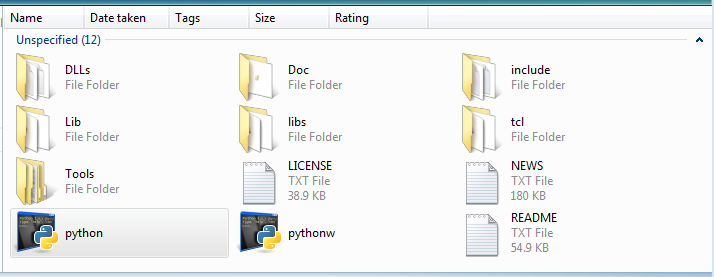
Make a file hello.py with the following line.
print("Hello world!")
The extension py is not required but for consistency, Python file usually has that extension.
If we run the file on a command prompt window:
C:\temp > python hello.py
Hello World
We typed the code into text file, and we run the file through the interpreter. Simple!
But let's think about the runtime structure of Python.
When we instruct Python to run our script, there are a few steps that Python carries out before our code actually starts crunching away:
-
It is compiled to bytecode.
-
Then it is routed to virtual machine.
PYTHON BYTE CODE
When we execute a source code, Python compiles it into a byte code. Compilation is a translation step, and the byte code is a low-level platform-independentrepresentation of source code. Note that the Python byte code is not binary machine code (e.g., instructions for an Intel chip).
Actually, Python translate each statement of the source code into byte code instructions by decomposing them into individual steps. The byte code translation is performed to speed execution.
Byte code can be run much more quickly than the original source code statements. It has .pyc extension and it will be written if it can write to our machine.
So, next time we run the same program, Python will load the .pyc file and skip the compilation step unless it's been changed. Python automatically checks the timestamps of source and byte code files to know when it must recompile. If we resave the source code, byte code is automatically created again the next time the program is run.
If Python cannot write the byte code files to our machine, our program still works. The byte code is generated in memory and simply discarded on program exit. But because .pyc files speed startup time, we may want to make sure it has been written for larger programs.
Let's summarize what happens behind the scenes.
When a Python executes a program, Python reads the .py into memory, and parses it in order to get a bytecode, then goes on to execute. For each module that is imported by the program, Python first checks to see whether there is a precompiled bytecode version, in a .pyo or .pyc, that has a timestamp which corresponds to its.py file. Python uses the bytecode version if any. Otherwise, it parses the module's.py file, saves it into a .pyc file, and uses the bytecode it just created.
Byte code files are also one way of shipping Python codes. Python will still run a program if all it can find are .pyc files, even if the original .py source files are not there.
PYTHON VIRTUAL MACHINE (PVM)
Once our program has been compiled into byte code, it is shipped off for execution toPython Virtual Machine (PVM). The PVM is not a separate program. It need not be installed by itself. Actually, the PVM is just a big loop that iterates through our byte code instruction, one by one, to carry out their operations. The PVM is the runtime engine of Python. It's always present as part of the Python system. It's thecomponent that truly runs our scripts. Technically it's just the last step of what is called the Python interpreter.
PYTHON PERFORMANCE
Unlike other compiled languages, Python code runs immediately after it is written. Byte code is a Python-specific representation. Since byte code is not a binary machine instructions, it requires more work than CPU instructions.
On the other hand, unlike other interpreters, there is still an internal compile step - Python does not need to reanalyze and reparse each source statement repeatedly. So, Python code runs at speeds somewhere between those of a traditional compiled language and a classic interpreted language.
PYTHON DEVELOPMENT
There is no distinction between the development and execution environments. In other words, the compiler is always right there at runtime and is part of the system that runs the program. All we have in Python is runtime. There is no initial compile-time phase at all and everything happens as the program is running.
This even includes operation such as the creation of functions and classes and the linking of modules. Such events occur before execution in more static languages, but in Python, they happen as programs execute.
This adds a more dynamic flavor to the Python - it is often very convenient for Python programs to construct and execute other Python programs at runtime. The eval andexec built-ins, for example, accept and run strings containing Python program code.
This structure is why Python lends itself to customization. Because Python code can be changed on the fly, users can modify the Python parts of a system onsite without needing to compile the entire system's code.